
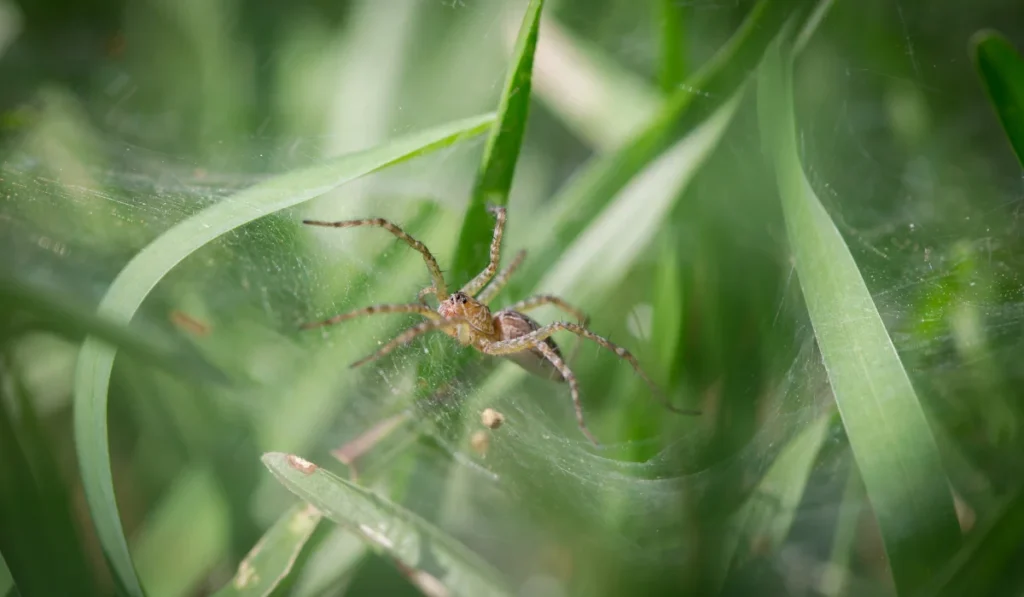
Thin, silvery webs can seem to cover an Oklahoma lawn overnight, especially after dew, fog, rain, or an early sprinkler cycle. In most cases, those low, funnel-shaped webs belong to grass spiders. These outdoor spiders build broad sheets of silk across grass, ground cover, shrubs, and sheltered spaces along foundations.
Funnel webs on lawn areas may look alarming when several appear at once. Their presence does not mean the spiders are damaging your grass, though. A grass spider is a predator that waits for insects and other small arthropods to cross its web.
For homeowners in Yukon, Mustang, Piedmont, Edmond, and Northwest Oklahoma City, the main questions are usually the same: Are grass spiders dangerous, should their webs be removed, and how can you keep them away from doors and outdoor living spaces? Correct identification helps you choose a measured response instead of treating every web as a serious problem.
Why Grass Spider Funnel Webs Appear on Your Lawn
A grass spider builds its web close to the ground, where crawling and low-flying insects are likely to encounter it. Grass blades, landscape edging, shrubs, mulch, foundation gaps, and dense ground cover provide stable anchor points. The spider creates a wide sheet of silk with a narrow funnel leading into a protected retreat.
The web does not trap prey with sticky silk. Instead, it acts like a sensitive platform. When an insect lands on or walks across the sheet, the spider detects the movement, runs from the funnel, and captures the prey.
The Missouri Department of Conservation’s grass spider guide notes that the sheet portion of a web may reach up to 3 feet wide, although most are smaller. The funnel can extend more than a foot into dense vegetation or another sheltered space. A single lawn may support many separate webs when the area offers enough cover and insect activity.
Why the Webs Stand Out in the Morning
Spider webs in grass are often difficult to see when the silk is dry. Moisture collects along the strands after a humid night, light rain, or irrigation, outlining the sheet and funnel with small droplets. The webs may seem to disappear later in the day as the moisture evaporates.
The dew did not cause the spiders to build dozens of webs overnight. It simply revealed webs that were already there. This is why a lawn may look clear in the afternoon but appear covered with grass spider webs the next morning.
How to Identify a Grass Spider and Its Web
Grass spider identification usually begins with the web rather than the spider. Look for a flat or slightly curved sheet lying across grass, weeds, ground cover, mulch, or the base of a structure. One side of the sheet narrows into a tunnel where the spider waits out of sight.
Grass spiders belong to the genus Agelenopsis and the funnel-weaver family Agelenidae. They are usually brown, gray, or tan, with darker stripes running lengthwise across the front section of the body. The abdomen often has a patterned stripe or series of markings.
Look for Long Spinnerets
One of the clearest physical features is the pair of elongated spinnerets at the back of the abdomen. These silk-producing structures may resemble two short tails. They are more noticeable on a grass spider than on many other common spiders found around Oklahoma homes.
Getting a close look can be difficult. Grass spiders move quickly and often retreat into the funnel when someone approaches, touches the surrounding grass, or casts a shadow over the web.
Follow the Shape of the Web
The web has two connected sections. The first is the horizontal sheet where the spider detects and catches prey. The second is the funnel-shaped shelter where it remains concealed.
Unlike an orb weaver’s circular web, a grass spider web does not have a neat wheel pattern. It may look dense, uneven, or layered, especially after collecting dirt, leaves, or insect remains.
Grass Spiders vs. Wolf Spiders and Other Lookalikes
Grass spiders are often mistaken for wolf spiders because both are commonly brown, fast-moving, and active near the ground. Their hunting behavior offers the easiest way to separate them. Grass spiders depend on funnel webs, while wolf spiders roam across soil, mulch, and floors to hunt without a capture web.
Orb weavers are easier to recognize once you compare their web shape. They suspend round, wheel-like webs between fences, shrubs, porch supports, and other raised objects. Grass spider webs remain low and spread horizontally across vegetation or landscaping.
| Feature | Grass Spider | Wolf Spider | Orb Weaver |
|---|---|---|---|
| Hunting method | Waits inside a funnel web | Hunts while roaming | Waits in or near a round web |
| Web shape | Horizontal sheet with a funnel | No capture web | Circular or wheel-shaped |
| Common location | Lawns, ground cover, shrubs, and foundations | Soil, mulch, cracks, and indoor floors | Gardens, fences, eaves, and shrubs |
| Useful identification clue | Long rear spinnerets | Stockier body without a funnel web | Rounded abdomen and patterned orb web |
They Are Not Australian Funnel-Web Spiders
The term funnel web spider can create unnecessary concern because it is also used for medically significant spiders found in Australia. Oklahoma grass spiders belong to a different family and pose a very different level of risk.
In local lawns, the terms grass spider and funnel weaver usually refer to members of the family Agelenidae. The shared wording describes the shape of the web, not a close relationship to dangerous Australian species.
Are Grass Spiders Dangerous or Helpful?
Grass spiders use venom to subdue their prey, as most spiders do, but they are not considered a serious medical threat to people. Their first response is usually to run into the funnel or away from a disturbance. Bites are uncommon and are most likely when a spider is trapped against the skin or handled.
According to Penn State’s grass spider profile, reported bites may cause localized pain, redness, swelling, or itching without serious consequences. Avoid picking up any unidentified spider with bare hands. Seek medical care for severe, spreading, or unusual symptoms after a suspected bite.
Grass spiders also provide a useful form of natural insect control. Their webs intercept beetles, moths, crickets, and other small arthropods moving through the landscape. The spider is not feeding on turf, roots, or ornamental plants.
A few webs along a fence, in a garden bed, or at the edge of the property can often remain undisturbed. The decision changes when the webs interfere with how you use the yard or when spider activity begins moving closer to the home.
Should You Remove Grass Spider Webs?
You do not need to remove every grass spider web you find. Webs in low-traffic parts of the property rarely justify direct control, especially when the spiders remain outdoors. Leaving some activity alone allows these predators to continue feeding on insects.
Removal makes more sense when webs repeatedly cover steps, sidewalks, patio furniture, play areas, or spaces around exterior doors. You may also need to act when large numbers of spiders gather along the foundation or begin appearing inside garages, bathrooms, basements, and other sheltered areas.
A broom, hose, or routine mowing can clear an individual grass spider web. Removing the silk alone may offer only temporary relief, however. If the same location still provides dense cover and a steady supply of prey, the spider may rebuild or another spider may take its place.
How to Reduce Grass Spider Activity Around Your Home
Grass spider control works best when you address the conditions that support both the spiders and their prey. Mow regularly, trim thick ground cover, cut back plants touching the siding, and remove leaf piles or brush near the foundation. Move firewood, unused pots, boards, and stored materials away from exterior walls when practical.
Pay close attention to outdoor lighting. Porch and security lights can attract moths and other insects after dark, creating an easy feeding area near doors and windows. Turn off lights that are not needed, or reposition fixtures so they draw insect activity away from primary entrances.
Seal gaps around doors, windows, vents, utility lines, and foundation openings to reduce indoor movement. Replace damaged screens and worn door sweeps. These steps will not eliminate every outdoor spider, but they can make it harder for them to enter the house.
The Oklahoma State University guide to common spiders explains that most spiders found in residential landscapes are harmless and beneficial. This supports a targeted approach focused on identification, exclusion, web removal, and correction of favorable conditions rather than treating every spider in the yard.
When Professional Grass Spider Control Makes Sense
Repeated web removal may not solve the problem when vegetation, exterior lighting, entry gaps, and other insect activity continue to support spiders near the home. Professional service may be appropriate when webs quickly return, spiders enter living spaces, or you cannot confidently identify the species.
A thorough inspection should look beyond the visible grass spider webs. It should identify active areas, potential entry points, sheltered web-building sites, and the insects that may be drawing spiders toward the structure. The findings can then guide a treatment plan suited to the home rather than a one-size-fits-all application.
Brandley Pest Control serves homeowners throughout Yukon, Mustang, Piedmont, Edmond, Northwest Oklahoma City, and nearby communities. Learn more about the company’s inspection-based approach at Brandley Pest Control, or contact the Brandley team when grass spider activity keeps returning around your lawn, entryways, or home.