
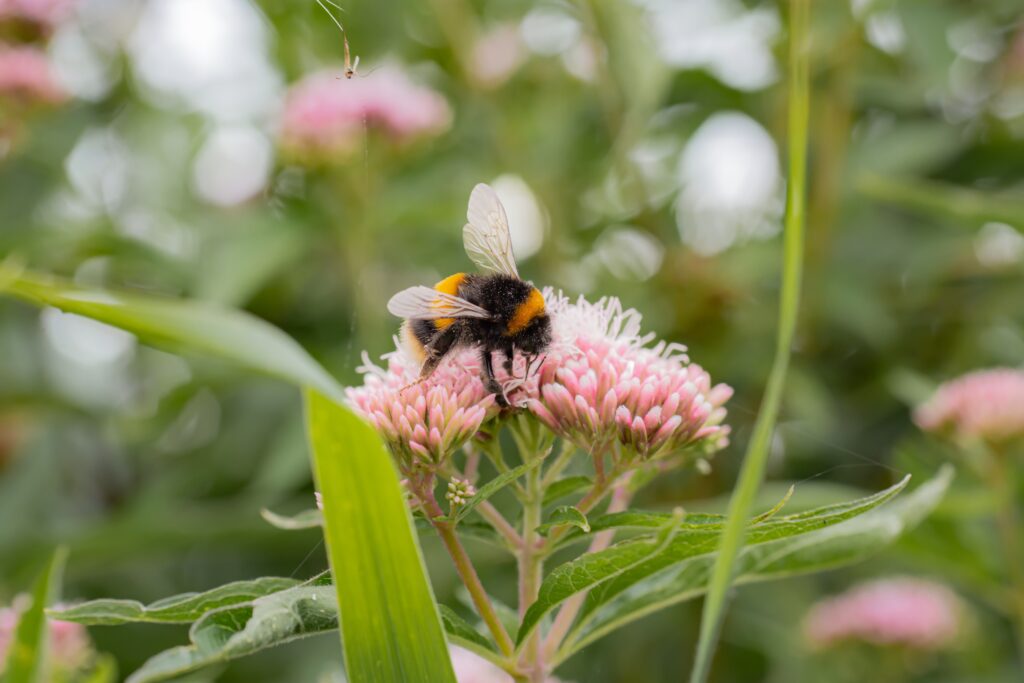
Mustang, OK sits squarely in bumble bee territory. Oklahoma has about 10 bumble bee species, and the American bumble bee is the one Mustang residents are most likely to encounter in yards, gardens, and around structures from spring through fall. Bumble bees are beneficial pollinators and generally docile, but a colony nesting in or against a structure is a different situation from one foraging in the garden.
Key Takeaways
- Oklahoma has about 10 bumble bee species. The American bumble bee is the most commonly encountered in the OKC metro area, including Mustang.
- Bumble bee colonies are active from spring through fall. Only mated queens survive winter; the rest of the colony dies off in fall.
- A bumble bee foraging in the yard is beneficial and rarely a stinging risk. A colony nesting under a deck, in a crawl space, or in a wall void warrants a professional assessment.
How to Identify a Bumble Bee in Mustang
Bumble bee vs carpenter bee vs yellow jacket
All three show up yellow and black in Mustang yards, but the abdomen and behavior separate a docile forager from an aggressive stinger.
Bumble bees are large, fuzzy, and yellow and black, features that make them easy to confuse with carpenter bees and, to a lesser extent, yellow jackets. The Oklahoma Department of Wildlife Conservation notes that all Oklahoma bumble bee species share a large body, black and yellow banding, and a distinctly hairy abdomen. Getting the identification right matters because the appropriate response to a bumble bee colony differs significantly from the appropriate response to a wasp or hornet nest.
The American Bumble Bee: What to Look For
The American bumble bee (Bombus pensylvanicus) is among the larger bee species in North America and the one Mustang residents are most likely to encounter. The Oklahoma Department of Wildlife Conservation describes the identification pattern: three black and two yellow bands, with the first yellow band just behind the eyes on the thorax and the second in the middle of the abdomen. The abdomen is covered in tiny hairs, giving the bee its characteristic fuzzy appearance. Females carry pollen on flattened sections of their hind legs called corbiculae, which are often visibly loaded with orange or yellow pollen during foraging.
Queens are larger than worker bees, particularly early in the season before the colony has built up. Workers are smaller and are the bees most commonly seen foraging on flowers throughout summer.
Bumble Bee vs. Carpenter Bee: The Key Difference
The most common misidentification in Mustang yards is confusing bumble bees with carpenter bees. Bumble bees have hairy abdomens with yellow markings; eastern carpenter bees have a largely bare, shiny black abdomen. If the bee you found has a glossy black rear end, it is almost certainly a carpenter bee. If the abdomen is fuzzy and banded yellow and black, it is a bumble bee. This distinction matters for homeowners because carpenter bees bore into wood to nest, while bumble bees nest in the ground or in pre-existing cavities.
Bumble Bee vs. Yellow Jacket: Size and Behavior
Yellow jackets are smaller and more slender than bumble bees, with a brighter, more defined yellow and black pattern and no visible fuzz. They are significantly more aggressive than bumble bees and will sting with little provocation. A large fuzzy bee moving slowly from flower to flower is almost certainly a bumble bee. A fast-moving, smooth-bodied insect that responds aggressively to proximity is almost certainly a yellow jacket or wasp.
When a Bumble Bee Nest Becomes a Problem
A bumble bee colony foraging in a Mustang garden is beneficial and requires no intervention. The situation changes when a colony establishes itself in or immediately adjacent to a structure where people regularly work or pass.
Ground-nesting bumble bees under a deck, against a foundation, or in a crawl space can create a stinging hazard for anyone who unknowingly disturbs the nest entrance. Worker bumble bees can sting multiple times, unlike honey bees. A nest near a frequently used door, pathway, or play area poses a practical risk that warrants removal rather than a wait-and-see approach.
Colonies that find their way into wall voids or structural cavities are less common but more difficult to address once established. The wax cells and stored pollen can attract other pests after the colony dies off in fall, which is a secondary reason to address structural nesting before winter.
Bumble Bee Season in Mustang, OK
Oklahoma’s climate supports bumble bee activity from early spring through fall, with the colony lifecycle following a predictable annual pattern. The fall die-off is the detail most relevant for Mustang homeowners: a colony left alone in a low-risk location will be completely gone by November without intervention.
Spring: Queens Emerge and Colonies Begin
Overwintering queens emerge in early spring and immediately begin foraging for nectar and pollen to fuel egg-laying. Each queen finds a suitable nest site, typically an abandoned rodent burrow or a cavity with loose fibrous material, and begins laying eggs. Eggs hatch in three to four days, and new worker bees emerge roughly a month after the colony is established. The first workers of the season are small; each successive brood grows larger as the colony develops.
Summer: Peak Activity in Mustang Yards and Gardens
Summer is when bumble bee colonies in Mustang are at maximum activity. Worker bees forage actively across yards and gardens to feed developing brood, and the colony grows steadily toward a few hundred bees by late summer. This is when bumble bees are most visible and when most homeowner encounters happen. Foraging workers are focused on flowers and rarely sting unless directly handled or stepped on. Males, produced later in the season, cannot sting.
Fall: Colony Decline and Queen Dispersal
New queens and male drones are produced in late summer and early fall, leave the colony to mate, and then disperse. The mated new queens feed heavily to build fat reserves, find a sheltered underground spot, and overwinter. The rest of the colony, including the original queen and all workers, dies off as temperatures drop. A bumble bee colony left in a low-traffic area of a Mustang yard will be completely gone by November without any treatment.
What Bumble Bees Are Doing in Your Mustang Yard
A bumble bee colony in the yard poses a fraction of the stinging risk of a wasp or hornet nest of comparable size. Colonies reach only a few hundred bees by late summer, compared to honey bee hives that can contain 20,000 to 60,000 bees. These are passive foragers focused on flowers, the colony does not persist year to year, and by late fall the entire population is gone.
Bumble bees forage for nectar and pollen to feed their colony and pollinate plants in the process. The Oklahoma State University fact sheet on bumble bee biology and the Oklahoma Department of Wildlife Conservation both describe the species as important native pollinators whose presence in a yard is a sign of healthy insect diversity rather than a pest problem.
When to Call Brandley Pest Control
Call us when a bumble bee colony has established itself in a location that creates a real stinging hazard: under a deck, near a frequently used door, in a crawl space, or in any location where accidental nest disturbance is likely. A colony visible in the garden or along a fence line, away from foot traffic, is generally best left until fall when it will die off naturally.
Professional service makes sense when:
- A ground nest is located near a door, walkway, play area, or any high-traffic zone.
- You or a family member has a known allergy to bee stings and any nest proximity is a concern.
- A colony appears to be nesting inside a wall void or structural cavity.
- You are unsure whether what you found is a bumble bee nest or a yellow jacket or wasp nest, which require different handling.
- Previous disturbance of the nest has already triggered defensive stinging.
Brandley Pest Control’s stinging insect services cover assessment and removal of stinging insect colonies across Mustang and the Oklahoma City metro, including same-day service for customers who call before 3 PM.
Schedule a Stinging Insect Assessment in Mustang
If you have found a bee or stinging insect colony on your property and are not certain what species it is or whether it poses a risk, we can assess the situation, identify the species, and recommend the appropriate response.
Contact Brandley Pest Control or call 405-467-4771 to schedule an assessment. Same-day service is available Monday through Friday for customers who call before 3 PM.
Frequently Asked Questions
Are bumble bees in Mustang dangerous?
Bumble bees are docile under normal circumstances. Worker females can sting and, unlike honey bees, can sting more than once. Males cannot sting. Most bumble bee stings occur when a bee is directly handled or when someone accidentally steps on or kneels near a nest entrance. A colony nesting in a high-traffic area poses a greater risk than one foraging in an open garden.
How do I tell a bumble bee from a carpenter bee?
Look at the abdomen. Bumble bees have hairy, yellow-and-black banded abdomens. Carpenter bees have a largely bare, shiny black abdomen. Both are large and yellow and black overall, but the texture and color of the abdomen settles the identification in most cases. Carpenter bees bore into wood to nest; bumble bees nest in the ground or in pre-existing cavities.
Do bumble bees in Mustang come back every year?
The same colony does not return. Bumble bee colonies are annual: the entire colony except mated new queens dies off in fall. New queens overwinter underground and start fresh colonies in spring. If bumble bees appear in the same area of your yard two years in a row, it is likely a new queen finding the same type of suitable habitat, not the same colony returning.
Should I treat a bumble bee nest in my yard?
A nest in a low-traffic area away from where people regularly work or walk is generally best left until fall, when the colony will die off naturally. A nest near a door, walkway, or play area, or one that has already produced defensive stinging, warrants professional removal. If you are uncertain, Brandley Pest Control can assess the location and recommend whether removal makes sense for your specific situation.