
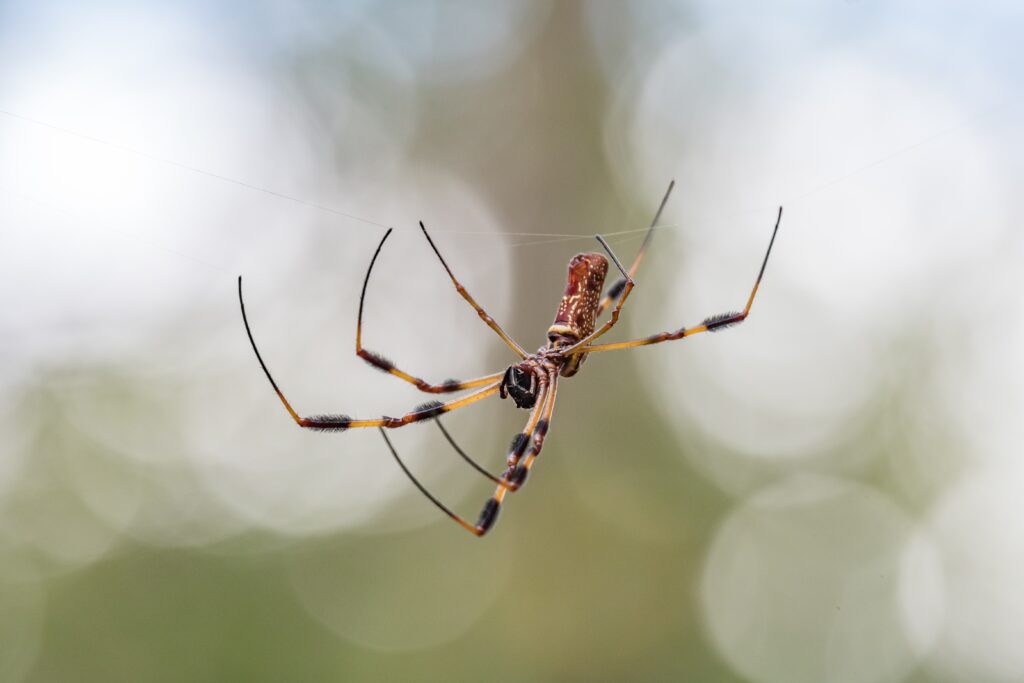
“Banana spider” in Oklahoma refers to two different species depending on who you ask: the golden silk orb-weaver (Trichonephila clavipes) and the black-and-yellow garden spider (Argiope aurantia). Both are large, visually striking, and entirely harmless to people. They are outdoor species, not household pests, and a bite from either requires direct provocation and causes only minor, temporary discomfort.
Key Takeaways
- “Banana spider” in Oklahoma most commonly refers to the golden silk orb-weaver or the black-and-yellow garden spider. Both are harmless outdoor species.
- Both species are most visible in late summer and fall, when females reach their full size and webs become large enough to be obvious in yards and gardens.
- Finding one in the yard is an incidental encounter with a beneficial predator. Neither species is a pest control concern.
Are Banana Spiders Actually Dangerous?
The golden silk orb-weaver and the black-and-yellow garden spider are both classified as not medically significant. A bite causes minor, localized irritation comparable to a bee sting at most, and biting requires direct provocation. The only two Oklahoma spiders considered medically significant are the brown recluse and the black widow; these orb-weavers resemble neither.
The Brazilian wandering spider (Phoneutria) also goes by “banana spider” in South America and is genuinely venomous. It is a South American species with no established population in Oklahoma, unrelated to the two orb-weavers covered here. Occasional encounters in the United States are typically traced to imported produce.
What “Banana Spider” Actually Refers to in Oklahoma
The common name “banana spider” creates genuine confusion because it applies to different species across different regions. In Oklahoma, the term is used most often for two harmless orb-weavers, and knowing which one you have comes down to three things: body color, web shape, and web structure.
| Feature | Golden Silk Orb-Weaver | Black-and-Yellow Garden Spider |
|---|---|---|
| Scientific name | Trichonephila clavipes | Argiope aurantia |
| Body length (female) | 1 to 2 inches | 3/4 inch to just over 1 inch |
| Abdomen color | Orange-brown to yellowish with white spots | Black with bright yellow banding |
| Cephalothorax | Silvery-white | White |
| Legs | Banded dark yellow and brown; black tufts near joints | Long, banded black and yellow |
| Web shape | Asymmetrical orb; hub near the top | Round orb; spider hangs in the center |
| Web color | Golden or amber in direct light | White/silver; no gold tint |
| Web marking | No zigzag | Distinctive zigzag stabilimentum through center |
| Danger to people | Not medically significant | Not medically significant |
The Golden Silk Orb-Weaver: The Classic Banana Spider
The golden silk orb-weaver (Trichonephila clavipes) is the species most specifically called a banana spider across the southern United States, and it is confirmed present in Oklahoma. Females are large, with a body length from 1 to 2 inches and legs extending well beyond that, a silvery-white cephalothorax, and an orange-brown to yellowish abdomen marked with white spots. The legs are banded dark yellow and brown with distinctive black brush-like tufts near the joints, which is one of the most reliable identification features. Males are much smaller, typically around a quarter inch, dark brown, and often found hanging in the female’s web.
The web is the other key identifier: golden silk orb-weavers spin an asymmetrical orb that appears gold or amber in direct light, owing to the yellow pigmentation of the silk. These webs can reach several feet in diameter and are anchored between trees and shrubs in wooded or partially wooded areas. The spider hangs in the hub of the web, which is positioned near the top rather than the center.
The Black-and-Yellow Garden Spider: Oklahoma’s More Common “Banana Spider”
The black-and-yellow garden spider (Argiope aurantia) carries the banana spider name in many parts of Oklahoma and is almost certainly the more commonly encountered of the two. Females have a bulbous abdomen with bright yellow and black banding and a white cephalothorax. Body length runs about 3/4 inch to just over an inch. Males are much smaller and brownish.
The web is a round orb with a distinctive zigzag band of thickened white silk running through the center, called a stabilimentum. This zigzag pattern is the fastest visual separator from the golden silk orb-weaver, which lacks it. The black-and-yellow garden spider is found throughout Oklahoma in gardens, fields, meadows, and along the edges of yards, often in sunny open areas with enough vegetation to anchor a web.
How to Tell Them Apart
Both are large, outdoor, web-building spiders active in late summer and fall. The fastest field separators:
- Web: The black-and-yellow garden spider has a distinctive zigzag pattern through the center. The golden silk orb-weaver’s web is plain with a golden tint and no zigzag.
- Body color: The golden silk orb-weaver has an orange-brown abdomen with white spots and banded legs with black tufts. The black-and-yellow garden spider has a black and bright yellow patterned abdomen.
- Web position: The golden silk orb-weaver’s hub sits near the top of the web. The black-and-yellow garden spider typically hangs in the center.
When Banana Spiders Are Most Active in Oklahoma
Both species follow the same general seasonal pattern tied to Oklahoma’s climate. Females grow continuously through spring and summer, which is why they seem to appear suddenly at full size in late August rather than building up gradually.
Summer Through Fall: Peak Visibility
Both species become most visible from midsummer through October in Oklahoma. Females reach maximum size in late August and September, which is when webs are largest and most likely to be noticed across yards, gardens, and tree lines. Activity decreases with the first hard frosts, adults of both species die off in late fall, and egg sacs are deposited before winter. New spiders hatch the following spring.
Why They Appear Near Homes
These spiders set up webs wherever there is sufficient structure to support them and enough flying insect activity to make the location productive. Gardens, porch edges, deck railings, outdoor light fixtures, and vegetation near the foundation are all common locations. They position themselves where prey is abundant rather than seeking entry into structures, and flying insects attracted to outdoor lighting provide a consistent food source through the warmer months.
Where Banana Spiders Turn Up Around Oklahoma Homes
Both species are outdoor spiders that anchor their webs to fixed structures. The specific locations depend on what provides web support, sunlight, and consistent insect traffic, all of which are common around the average Oklahoma yard and home exterior.
Common Outdoor Locations
The black-and-yellow garden spider favors open, sunny spots with vegetation sturdy enough to support a two-foot web. In Oklahoma yards this typically means garden beds, tall ornamental grasses, shrub borders, fence lines, and the edges of lawns where mowed grass meets taller growth. Porch corners and deck railings are also frequent sites, especially where plants are nearby.
The golden silk orb-weaver gravitates toward partially shaded, wooded edges rather than fully open areas. Look for it between trees, along the margins of wooded sections of a property, in gaps between large shrubs, or spanning the space between an outbuilding and adjacent vegetation. Its webs are larger and more often noticed when they span a path or gap that people walk through.
Near the Home: Eaves, Porches, and Exterior Lighting
Outdoor light fixtures are a reliable draw for both species. Flying insects accumulate around porch lights and floodlights after dark, and a web positioned near that light source catches prey through the night. Eave corners, the space between porch columns, and gaps between siding and window frames all provide web anchor points with strong insect traffic nearby.
Both species are entirely outdoor spiders. Finding one inside a structure is an accidental entry rather than normal behavior, and it is far less common than finding webs outside. A spider found deep inside the home is almost certainly a different species.
What These Spiders Actually Do
The golden silk orb-weaver and the black-and-yellow garden spider are passive ambush predators. They build large webs, wait for flying insects to hit them, and are genuinely useful in a yard or garden context.
Mosquitoes, flies, grasshoppers, moths, wasps, and beetles all fall prey to these spiders’ webs. This feeding behavior reduces pest insect populations without any intervention on the homeowner’s part. These spiders are docile toward people. The typical encounter is accidental contact with the web, which is startling but harmless. A bite from either species requires direct handling or entrapment against skin and produces only localized, temporary discomfort.
When to Call Brandley Pest Control
A banana spider in the yard is rarely a pest control situation. Finding one or two large orb-weavers in the garden in late summer is a normal Oklahoma yard occurrence. Brandley Pest Control is the right call when you have concerns about spider identification and want confirmation before deciding on a response, when you are finding multiple spider species indoors and want a professional assessment, or when overall spider activity on the property has increased in a way that suggests an underlying insect population driving it.
Professional service makes sense when:
- You are not certain of the species and want confirmation before handling or removing a spider.
- You are finding spiders indoors repeatedly and want the species identified.
- Outdoor spider activity has increased significantly and you want the yard assessed.
- You want to address the insect population that may be drawing spiders close to the home.
Brandley Pest Control’s residential pest control services cover spider identification, de-webbing, and treatment for indoor spider activity and the insect populations that support it across the Oklahoma City metro.
Schedule a Spider Inspection in Oklahoma City
If you have found a spider you cannot identify or want a professional assessment of spider activity on your property, we can inspect, identify the species, and recommend next steps based on what is actually present.
Contact Brandley Pest Control or call (405) 296-2470 to schedule an inspection. Same-day service is available for customers who call before 3 PM.
Frequently Asked Questions
Is the banana spider in Oklahoma dangerous?
No. Both species called banana spiders in Oklahoma, the golden silk orb-weaver and the black-and-yellow garden spider, are not medically significant. Bites are extremely rare, require direct provocation, and cause only minor localized discomfort comparable to a bee sting.
What is the difference between a banana spider and a garden spider in Oklahoma?
In Oklahoma, these names often refer to the same spider or to closely related orb-weavers. The black-and-yellow garden spider (Argiope aurantia) is frequently called a banana spider locally. The golden silk orb-weaver (Trichonephila clavipes) is the species most specifically called a banana spider in the southern states. Both are large, harmless outdoor orb-weavers. The clearest visual separator is the web: the garden spider has a distinctive zigzag stripe through the center; the golden silk orb-weaver’s web is plain with a golden tint.
When do banana spiders come out in Oklahoma?
Both species are most active and most visible from midsummer through October in Oklahoma. Females grow throughout the season and reach full size in late August and September. They die off with the first hard frosts, and new spiders hatch from egg sacs in spring.
Should I remove a banana spider from my yard?
There is no pest control reason to remove either species from an outdoor setting. Both are beneficial predators that feed on mosquitoes, flies, and other pest insects. If a web is in a high-traffic area, relocating the spider with a container is the practical approach. Direct handling is not recommended because it may provoke a bite, though the bite is not medically significant.