
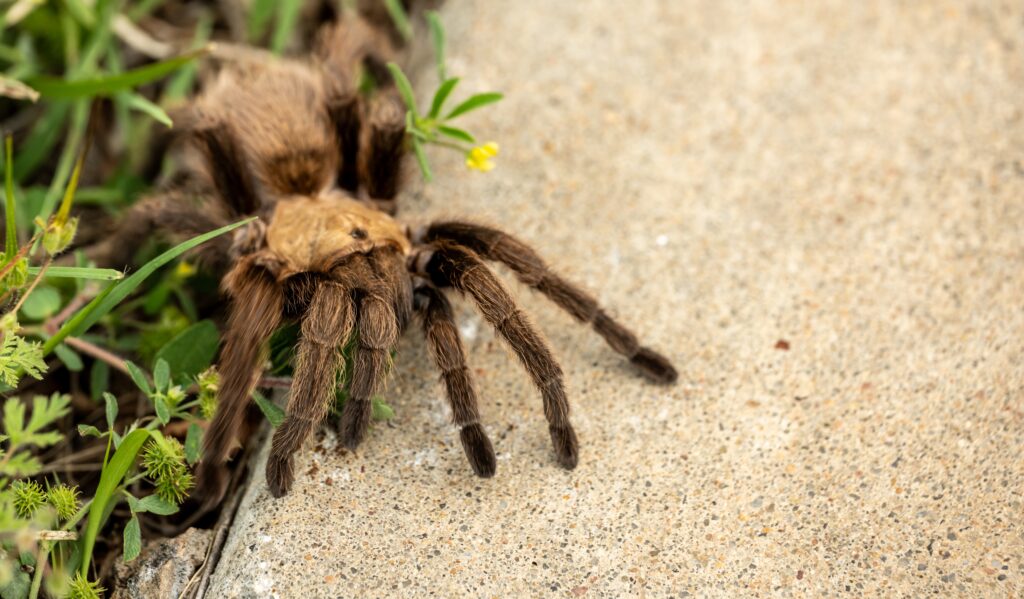
Oklahoma has one tarantula species: the Oklahoma brown tarantula (Aphonopelma hentzi). Oklahoma State University confirms it is the state’s largest spider and classifies its bite as no more harmful than a bee sting. It is docile, ground-dwelling, and not a household pest. Males become visible in late summer and fall when they wander in search of females, which is when most Oklahoma homeowners encounter them.
Key Takeaways
- The Oklahoma brown tarantula is the only tarantula species documented in Oklahoma. Its bite is not medically significant, comparable to a bee sting.
- Males wander in late summer and fall, typically from late August through October, which is when most sightings happen near homes and roads.
- Urticating hairs on the abdomen are the tarantula’s primary defense. These barbed hairs can cause skin and eye irritation and are a more practical concern than the bite for most people.
When Oklahoma Tarantulas Are Most Active
Tarantula sightings in Oklahoma cluster in two predictable windows: the male wandering season in fall and the occasional year-round sighting of a female or immature spider disturbed from its burrow. The fall window is the one most Oklahoma homeowners encounter.
The Fall Wandering Season: Late August Through October
The most visible period for tarantulas in Oklahoma is the male wandering season. Andrine Shufran, director of the Oklahoma State University Insect Adventure, has described mating season as running from late August through October, triggered by temperature and microclimates rather than a fixed date. During this window, males leave their burrows and travel significant distances across open ground searching for females. This is when tarantulas are seen crossing roads, moving through yards, and occasionally entering structures through gaps at ground level.
Males emerging in this period are in the final phase of their lives. They die within weeks to months after mating, regardless of whether they find a mate. Females, who remain in their burrows, can live 15 to 20 years.
Year-Round: Females Stay Hidden
Female Oklahoma brown tarantulas remain in their burrows for most of the year and are rarely seen above ground. They are mostly nocturnal, hiding during the day in natural cavities, abandoned rodent tunnels, or burrows they have excavated themselves. The burrow entrance is lined with silk, which serves as a vibration detector to alert the spider to passing prey. Females emerge at night to hunt near the burrow entrance.
Outside of the fall wandering season, tarantula sightings almost always involve females or immature spiders disturbed from their burrows during yard work, landscaping, or construction.
What to Do When You Find One
A tarantula near or inside your home is almost always a seasonal wanderer, not a resident pest. Relocating it is the correct response in most cases, and professional pest control is rarely necessary.
If a tarantula is found indoors, place a large container over the spider, slide a stiff piece of paper underneath to seal it, and carry it outside. Release it in a natural area away from the structure. Do not attempt to handle it directly, especially if you have sensitive skin or eyes.
If tarantulas are regularly appearing near the foundation during fall, they are likely moving through rather than nesting. Sealing ground-level gaps, especially around doors and foundation penetrations, reduces the chance of accidental entry.
How to Identify the Oklahoma Brown Tarantula
The Oklahoma brown tarantula is large enough that identification is rarely in doubt. The combination of size, color, and texture is distinctive.
| Feature | Oklahoma Brown Tarantula |
|---|---|
| Scientific name | Aphonopelma hentzi |
| Body length | Up to 2 inches (female); males smaller and more slender |
| Leg span | 4 to 6 inches |
| Color | Dark brown to nearly black; males develop black legs with copper carapace after final molt |
| Coat | Dense, velvety hair across the body; barbed urticating hairs on abdomen |
| Eyes | 8 eyes in two rows near the front of the carapace |
| Web | No aerial web; burrows in ground, lines entrance with silk |
| Danger to people | Bite comparable to bee sting; urticating hairs cause skin and eye irritation |
| Female lifespan | 15–20 years |
| Male lifespan | Dies within weeks to months after mating |
Size and Body Shape
Adult females have a body length of about 2 inches with a leg span reaching 4 to 6 inches. Males are smaller and more slender, with thinner legs and a copper-colored carapace after their final molt, which matters for the seasonal context since males are the ones wandering in fall. The body is stout and covered with hollow, needle-like, barbed hairs, particularly on the abdomen.
Color and Coat
The body is brown to dark brown, sometimes nearly black. Females tend to be darker and more uniformly colored. Males, especially after molting, develop black legs with the copper carapace. Both sexes are covered in dense hair that gives the body a velvety appearance. The abdominal hairs are the most notable: fine, barbed, and easily shed when the spider feels threatened.
How to Tell It From a Wolf Spider
The Oklahoma brown tarantula is sometimes confused with large wolf spiders, but size settles it quickly in most cases. A tarantula is substantially larger and stouter, moves more slowly, and has the rounded, prominent abdomen that wolf spiders lack. If the spider you found is moving fast and looks alert and agile, it is almost certainly a wolf spider. If it is large, slow, and velvety-looking, it is almost certainly a tarantula.
What a Tarantula Actually Does and Eats
The Oklahoma brown tarantula is a passive ambush predator with no interest in human contact. It spends most of its life inside a burrow, emerging at night to hunt near the entrance rather than roaming in search of food.
The Oklahoma Department of Wildlife Conservation notes that the tarantula does not weave aerial webs to trap prey. Instead, it burrows into the ground and waits near the entrance, sensing vibrations from grasshoppers, crickets, beetles, and other insects. When prey comes within range, the tarantula moves quickly to overpower it. The silk lining the burrow entrance functions as an alarm system for predators approaching from above.
Tarantulas also face significant predation from tarantula hawks, large spider wasps that paralyze a tarantula, drag it into a burrow, and lay an egg on it. A tarantula hawk encounter is more alarming for a person to witness than to be involved in, but the presence of these wasps in an area is a reliable indicator that tarantulas are nearby.
The Urticating Hairs: The More Practical Concern
For most people, the tarantula’s bite is far less likely to cause a problem than its hairs. Some people may develop hypersensitivity reactions to the body hairs, which is a more relevant warning than the bite risk for the majority of encounters.
When threatened or handled carelessly, the Oklahoma brown tarantula will rub its hind legs against the abdomen and flick barbed hairs toward the perceived threat. These hairs are designed to embed in skin and are particularly irritating to the eyes. Anyone who has picked up a tarantula and rubbed their face afterward, or who has had hairs blown toward their eyes on a windy day, can attest that the urticating hair reaction is genuinely unpleasant.
Do not handle a tarantula unless you understand this risk. If you need to move one, use a container rather than your hands.
When to Call Brandley Pest Control
A single tarantula in or around the home is rarely a pest control situation. Brandley Pest Control is the right call when you cannot confirm the species and want identification before responding, when spider activity indoors is recurring, or when overall spider pressure, including smaller indoor species, is a persistent issue rather than an isolated encounter.
Professional service makes sense when:
- You are finding multiple spiders indoors and are not certain of the species.
- Recurring spider activity suggests an underlying insect population supporting them.
- You want the foundation perimeter inspected and treated before fall spider movement peaks.
- You want a professional identification to confirm what you found is a tarantula and not a brown recluse or another species.
Brandley Pest Control’s Pest Maintenance Plan covers spider activity as part of standard home pest control, including identification, de-webbing, and crack-and-crevice treatment that targets the insect populations supporting indoor spider activity.
Schedule a Spider Inspection in Oklahoma City
If you are finding spiders indoors and want a clear identification and assessment, we can inspect the property, identify the species, and recommend an approach based on what is actually present.
Contact Brandley Pest Control or call 405-987-4186 to schedule an inspection. Same-day service is available for customers who call before 3 PM.
Frequently Asked Questions
Is the Oklahoma brown tarantula dangerous?
No. OSU Extension classifies the bite as no more harmful than a bee sting. The species is docile and bites only when directly handled or provoked. The more practical concern for most people is the urticating hairs on the abdomen, which can cause skin and eye irritation when the spider feels threatened.
Why are tarantulas crossing roads in Oklahoma in fall?
Male Oklahoma brown tarantulas wander in search of females during the mating season, which runs from late August through October. During this period, males travel across open ground covering significant distances, which is why they are commonly seen crossing roads and moving through yards. Females remain in their burrows and are rarely seen during this time.
Do tarantulas nest inside houses in Oklahoma?
No. Oklahoma brown tarantulas are ground-burrowing spiders. They do not build indoor nests or establish colonies inside structures. A tarantula found indoors has almost always wandered in accidentally through a ground-level gap. Relocating it outside is the appropriate response.
How long do Oklahoma tarantulas live?
Males die within weeks to months after reaching sexual maturity and mating. Females live substantially longer: OSU Extension documents females living 15 to 20 years, and captive specimens have been documented living up to 30 years. This lifespan difference means virtually all the tarantulas seen wandering in fall are short-lived males.