
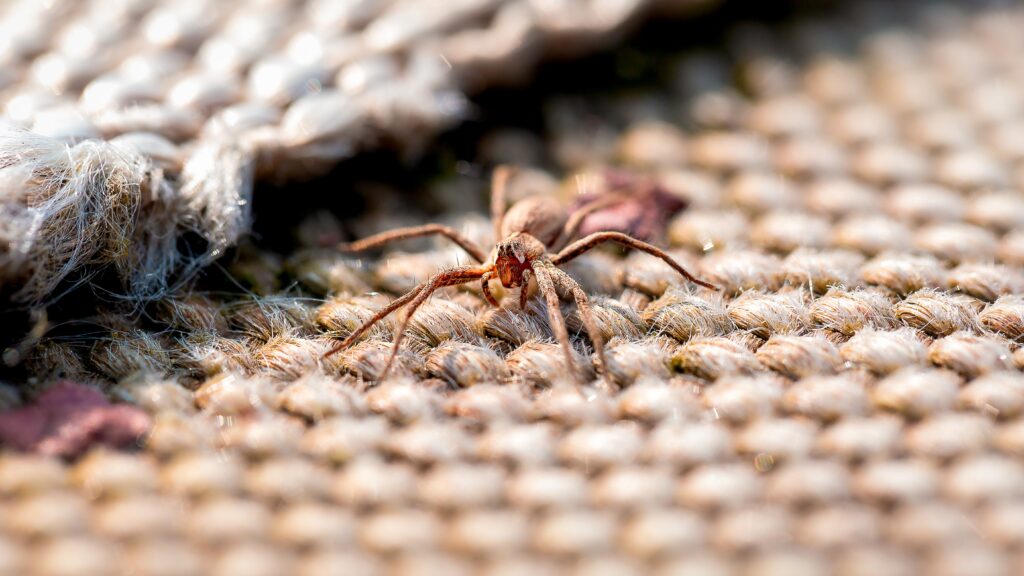
Wolf spiders in Oklahoma are common, alarming to encounter, and not medically significant. OSU Extension classifies them as harmless to people, though their size, speed, and hairy appearance make them one of the most frequently reported spiders by homeowners in the OKC metro. They enter homes in fall looking for warmth, they hunt at night without building webs, and they are most often mistaken for brown recluses. Knowing what you’re actually looking at changes how you respond.
Key Takeaways
- Wolf spiders are not dangerous. OSU Extension confirms bites may cause mild reactions in sensitive individuals but the species is not considered medically significant.
- The fastest way to tell a wolf spider from a brown recluse: look for the violin marking. Wolf spiders don’t have one. Brown recluses do.
- Wolf spiders are most common indoors in fall when they seek warmth. They are nocturnal hunters that follow prey inside rather than establishing permanent indoor colonies.
How to Identify a Wolf Spider in Oklahoma
Wolf spiders share enough surface-level features with the brown recluse that misidentification is common. OSU Extension specifically notes this confusion and points to the violin marking as the key separator: wolf spiders lack it entirely. Two species are confirmed in Oklahoma and both show up around homes.
| Feature | Carolina Wolf Spider | Rabid Wolf Spider |
|---|---|---|
| Scientific name | Hogna carolinensis | Rabidosa rabida |
| Size | Body up to 1 inch; legs make overall spider look much larger | Females up to 1 inch; males about 1/2 inch |
| Color | Brownish-black with slate-grey hairs | Predominantly yellow with two dark stripes on cephalothorax, one on abdomen |
| Eyes | 8 eyes in 3 rows; large middle row reflects light | 8 eyes in 3 rows; large eyes reflective |
| Web | None — active ground hunter | None — nocturnal ambush hunter |
| Habitat | Ground level; burrows in soil; enters homes in fall | Wooded areas, cotton fields, grassy habitat; enters homes occasionally |
| Danger to people | Not medically significant; bite like bee sting | Not medically significant |
The Carolina Wolf Spider: Oklahoma’s Largest Indoor Visitor
The Carolina wolf spider (Hogna carolinensis) is one of the largest wolf spider species in North America and the one most likely to cause alarm when found indoors. The body runs up to about an inch in length with legs that make the overall spider look substantially larger. The coloring is brownish-black with slate-grey hairs covering the body, giving it a dense, textured appearance. Like all wolf spiders, the Carolina wolf spider has eight eyes arranged in three rows, and the large middle row of eyes reflects light. Shine a flashlight toward a wolf spider in a dark room and those eyes will glow.
Carolina wolf spiders do not build webs. They are active ground hunters that rely on speed to chase down grasshoppers, crickets, beetles, and other arthropods. When shelter is needed, they burrow into the ground. They enter homes primarily to hunt prey, not to establish a permanent residence. Finding one inside is usually a single-incident entry rather than evidence of a colony.
The Rabid Wolf Spider: Smaller, Wooded Areas, Still Harmless
The rabid wolf spider (Rabidosa rabida) has an alarming name and is entirely harmless. The name refers to an old observation about its erratic movement pattern and has nothing to do with medical risk. Females reach about an inch in body length; males are around half an inch. The coloring is predominantly yellow with two dark stripes running lengthwise along the cephalothorax and one stripe along the abdomen.
Rabid wolf spiders prefer wooded areas, cotton fields, and grassy habitat rather than structures. They may enter homes to hunt but are not well-suited to indoor environments and do not stay long. OSU Extension notes they are nocturnal ambush hunters that hide in holes or burrows covered with silk or debris rather than using exposed webs.
The One Feature That Confirms a Wolf Spider Every Time
Any wolf spider found in Oklahoma will have the characteristic eye arrangement: four small eyes in the bottom row, two large eyes in the middle row, and two medium eyes on top. The large middle eyes produce a reflective eyeshine that is the fastest single identifier for this family. Shine a light toward the spider in a dim room. If the eyes glow, it’s a wolf spider.
Why Wolf Spiders Enter Oklahoma Homes
Wolf spiders follow two things into Oklahoma homes: temperature and prey. In fall, both conditions shift at the same time, outdoor temperatures drop while insects move toward structures, which is why October and November produce the most indoor sightings.
Fall Entry: Following Warmth Into the Structure
As Oklahoma temperatures drop in October and November, wolf spiders that have been active in yards and gardens throughout summer begin moving toward structures for warmth. OSU Extension notes they are commonly found around doors, windows, house plants, basements, and garages at this time of year. They enter through gaps around door sweeps, foundation cracks, utility penetrations, and gaps around window frames, the same access points that allow other fall-invading insects indoors.
Unlike cockroaches or silverfish, wolf spiders don’t breed indoors or establish populations inside a structure. A wolf spider that enters in fall is looking for a sheltered overwintering spot, not setting up a colony.
Prey Availability: Insects Draw Them In
Wolf spiders that appear indoors outside of fall are almost always following prey. A home with consistent insect activity, flies near a food source, crickets along the foundation, silverfish in a damp basement, provides hunting opportunities that attract wolf spiders year-round. Reducing the insect population inside the structure reduces the incentive for wolf spiders to come looking.
How to Reduce Wolf Spider Activity Around Oklahoma Homes
Reducing wolf spider activity requires two things: sealing the access points they use to enter and reducing the insect population they follow inside. Neither requires treating the spider directly.
Seal the Access Points Before Fall
The most effective timing for entry-point work is late summer, before Oklahoma’s fall temperatures trigger the movement toward structures. Checking and replacing worn door sweeps, sealing gaps around utility penetrations through the foundation, and caulking around window frames eliminates the routes wolf spiders use to enter. These are the same gaps that allow crickets, beetles, and other fall-invading insects inside, so sealing them reduces both wolf spiders and the prey that draw them.
Reduce the Insect Population They Follow
Exterior lighting attracts flying insects, which attract the spiders that hunt them. Switching exterior lights to yellow-spectrum bulbs reduces flying insect accumulation near the foundation. Clearing leaf litter and wood debris from the perimeter removes the harborage that supports ground-dwelling insects wolf spiders hunt. Reducing moisture near the foundation and eliminating standing water addresses the same conditions.
The Egg Sac and Spiderlings: What to Know
Female wolf spiders carry their egg sac attached to their spinnerets rather than leaving it in a web or fixed location. This behavior distinguishes them from most other spider families and is another field identification clue. After the eggs hatch, the spiderlings climb onto the mother’s back and ride with her until they are partially grown, which can make a single female wolf spider look substantially larger or appear to be moving strangely.
Finding a female wolf spider carrying spiderlings indoors is alarming but does not indicate an indoor breeding population. The spiderlings will disperse as they mature. No intervention beyond removing the individual spider is typically necessary.
When to Call Brandley Pest Control
Call us when wolf spiders are appearing repeatedly inside the home across multiple areas, when fall entry is happening despite your own sealing attempts, or when you are unsure whether the spider you found is a wolf spider or a brown recluse. A single wolf spider indoors is rarely a reason for treatment. Recurring sightings across different rooms in October or November usually mean entry points remain open or a prey insect population is sustaining ongoing activity.
Professional service makes sense when:
- You are finding wolf spiders repeatedly in the same areas of the home.
- Fall entry is occurring despite sealing and you cannot locate the remaining access points.
- You want the entry points inspected and treated before the October–November peak.
- You are not certain whether the spider you found is a wolf spider or a brown recluse.
- You want the interior insect population addressed to remove the food source attracting spiders.
Brandley Pest Control’s Pest Maintenance Plan covers spiders as part of standard home pest control, including crack-and-crevice treatment along the foundation perimeter, de-webbing, and insect control that removes the prey species sustaining indoor spider activity.
Schedule a Spider Inspection in Oklahoma City
If you are seeing wolf spiders indoors and want to know what is drawing them in and where they are entering, we can inspect the property, identify the access points, and recommend a treatment plan that addresses the underlying conditions.
Contact Brandley Pest Control or call 405-987-4186 to schedule an inspection. Same-day service is available for customers who call before 3 PM.
Frequently Asked Questions
Are wolf spiders in Oklahoma dangerous?
No. OSU Extension classifies wolf spiders as not poisonous, though bites may cause mild reactions in some individuals. The bite is generally comparable to a bee or wasp sting, painful but not medically significant. Wolf spiders are shy and avoid contact; bites typically occur when the spider is directly handled or accidentally compressed.
How do I tell a wolf spider from a brown recluse?
Look for the violin marking on the cephalothorax. Brown recluses have a distinctive fiddle-shaped marking on the top of the body; wolf spiders do not. Wolf spiders are also hairier, larger in overall appearance, and have a distinctive eye arrangement with two large reflective eyes in the middle row. If you can safely observe the spider with a light, the eyeshine from those middle eyes confirms wolf spider.
Why are wolf spiders coming into my house in fall?
OSU Extension documents wolf spiders as a common fall household pest in Oklahoma. As temperatures drop, they move from outdoor habitats toward structures for warmth, entering through gaps around doors, windows, and the foundation perimeter. They are also following the prey insects that move indoors for the same reason. Sealing entry points before October and reducing the interior insect population are the two most effective preventive steps.
Do wolf spiders breed inside houses?
No. Wolf spiders do not establish indoor colonies or breed inside structures. They enter to hunt or seek warmth and do not build webs or maintain a fixed nest location inside a home. A female carrying spiderlings indoors is alarming visually, but the spiderlings will disperse naturally. No specific treatment for the spiderlings is necessary beyond removing the female.