
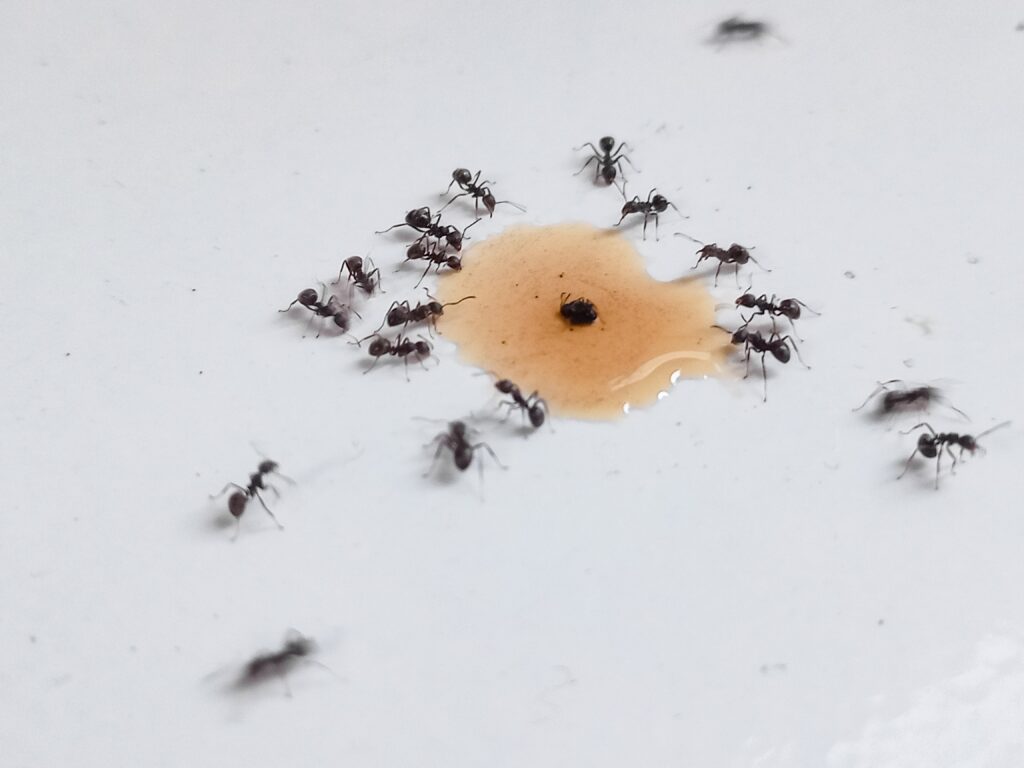
Ants moving across countertops or along baseboards can quickly turn into a persistent ant problem, especially during Oklahoma’s warm seasons when pest activity increases indoors.
Several types of ants can show up inside homes, but two of the most common are sugar ants and grease ants. Each type is attracted to different food sources and behaves differently indoors. Knowing which one you’re dealing with helps you choose the right way to get rid of ants.
This guide covers ant identification, common attractants, indoor hotspots, and when pest control becomes the most effective option for long-term ant control.
Key Takeaways About Sugar Ants Vs Grease Ants
Sugar ants vs. grease ants
These names describe food preference, not one species. Matching the type guides the right bait.
- The terms “sugar ants” and “grease ants” describe ant groups by the foods they prefer rather than a single species. Some ants favor sugary foods, while others are drawn to oils and proteins.
- Knowing which food preference your ants have helps you choose the right bait, because a bait that does not match what the ants are foraging for is unlikely to be carried back to the colony.
- Proper identification matters beyond just food preference. Nest location, body size, and trail behavior all factor into an approach that addresses the colony, not just the ants you see indoors.
- Reducing access to the foods that attract ants in your home is one of the most practical steps you can take alongside any treatment.
How to Identify Sugar Ants Vs Grease Ants
The terms “sugar ants” and “grease ants” are informal names that describe ant species by the foods they prefer. Understanding which type you are dealing with matters because bait must contain a food substance attractive to the target ant species so that foraging workers will collect it, return it to the colony, and feed it to the other ants. Using the wrong bait can leave the nest untouched.
How to Tell Sugar Ants vs. Grease Ant Types Apart
Different ant species vary in worker length, nesting preference, swarming season, and whether they sting, bite, or follow trails. These details, outlined in identification charts from Texas A&M AgriLife Extension, help narrow down which species you are seeing. Because “sugar ant” and “grease ant” each cover multiple species, appearance alone may not give you a definitive answer. Watching what the ants are drawn to can be just as useful as size or color.
Sugar Ants vs. Grease Ants: Key Differences
Sugar ants and grease ants are small ants commonly found indoors, which is why they are often confused. Sugar ants refer to several sweet-seeking species of ants, while grease ants usually refer to very small ants that prefer fats. Because different ant species can look similar at first, misidentification is common. Below are clear identification factors you can use.
| Characteristic | Sugar Ants | Grease Ants |
| Size | about 2 mm to 3 mm in length | about 1 mm to 1.5 mm long |
| Color | light brown, dark brown, black ants, or reddish-brown, depending on the ant species | light brown or pale yellow, and may look slightly translucent |
| Shape | – segmented body with a defined waist – smoother thorax – bent antennae | – more compact body – a defined thorax – segmented antennae |
| Behavior | form visible ant trails | move in scattered patterns |
| Odor | Some sugar ants, such as odorous house ants, release a noticeable smell when crushed. | Grease ants do not produce a strong odor. |
| Nesting Habits | nest outdoors | often nest indoors |
| Common Species | – odorous house ants – Argentine ants – pavement ants – acrobat ants | – thief ants – pharaoh ant |
How to Spot Ant Activity Inside Your Home
Worker ants from outside or inside nests may forage for food and water inside your home. Foraging workers of some species secrete pheromone trails to lead other ants to food and water. If you notice a steady line of ants moving along a countertop or wall, those trails are a strong sign of an active nest nearby.
The ants take food back to the colony and share it with the other ants, including the queen and brood. That means the handful of workers you see represent a much larger group you do not see.
Where Ant Activity Shows Up Around Homes
Some species often nest indoors, while others nest outside and enter your home just to look for food. Knowing whether the nest is inside or outside changes the approach needed. Simply removing the visible foragers does not address the colony itself, and treatments targeting only ant trails kill just a few foraging workers and do not reach the nest.
Some species produce winged ants that swarm from the nest during certain times of the year, mate, and then form new colonies. Newly mated females may choose indoor nesting sites if suitable ones are not available outdoors. Seeing winged ants inside your home can point to a nest within the structure.
Exterior Entry Points Sugar Ants and Grease Ants Use
Worker ants foraging from outside nests follow pheromone trails through any gap that connects the outdoors to your living space. Sealing those pathways can reduce the number of foragers reaching interior rooms. However, the colony or nest must still be addressed to stop the activity at its source.
Why Sugar Ant and Grease Ant Problems Develop
The sugar ants vs grease ants comparison comes down to food preference. As Texas A&M AgriLife Extension notes, some ant species feed mostly on sugar or sucrose, while others prefer oils or proteins. That single difference shapes where each type forages inside your home and why a one-size-fits-all approach often falls short.
Outdoor Nesting Areas for Sugar Ants and Grease Ants
Both sugar-feeding and grease-feeding ants typically nest outdoors and send foragers inside to find food. In most ant species, one queen per nest lays the eggs, maintaining or increasing the colony size over time. When an outdoor nest is close to your home, foragers can reach indoor food sources within minutes and repeatedly.
Food and Shelter Attracting Sugar Ants and Grease Ants
Sugar ants target sweets, sugar, syrup, honey, and jelly. Grease ants gravitate toward oils, proteins, meats, and pet food. Ants are attracted to varying food sources throughout the year, so a colony that focuses on sweets one month may shift toward protein the next. Cleaning up food that attracts ants, including sweets, sugar, pet food, grease, and protein, helps reduce what draws both types indoors.
How Sugar Ants and Grease Ants Move Around Homes
In many species, foragers create a pheromone trail that helps the rest of the colony find a food source or water. Once a trail is established, dozens of workers can follow it to your kitchen or pantry. Without that scent trail, ants lose their way to the food source and are forced either to reestablish the trail or to forage elsewhere. Disrupting trails is one reason thorough cleaning matters.
Trails Sugar Ants and Grease Ants Use
Both sugar-feeding and grease-feeding ants follow their pheromone trails through small gaps to reach indoor food. Removing other food sources, such as spilled food and grease, cuts off the reward that keeps those trails active. When the food source disappears, foragers may still explore for a time, but the trail loses its pull on the broader colony.
Risks From Sugar Ants vs. Grease Ants
Whether you are dealing with sugar ants or grease ants, the practical risks overlap more than most homeowners expect. Both types of pests can nest outdoors or indoors, and both become a problem once foraging workers find a way inside your home. The real differences show up in where they trail, what draws them in, and how persistent the activity can become.
Health Risks Linked to Sugar Ants and Grease Ants
Most ant species that homeowners call sugar ants or grease ants nest outdoors and become nuisance pests when they forage inside. According to Kansas State University Extension, if foraging ants find food, they may bring in others, creating characteristic trails that become a source of disgust and irritation. While these pests are not typically associated with structural harm, persistent indoor trails around food areas raise sanitation concerns for any household.
Property Damage From Sugar Ants and Grease Ants
Some ant pests can nest in areas that put your property at greater risk. Colonies may establish themselves in wall voids, basements, attics, crawl spaces, garages, and even trees near your home. Certain species form large colonies containing tens of thousands of ants, which can make the problem harder to address once trails are well established. Carpenter ants, sometimes grouped with sugar-loving species, range from 1/4 to 5/8 inches and are among the largest pest ants homeowners may encounter.
Food Areas and Ant Activity
Kitchens and pantries are the areas where sugar ant and grease ant activity usually becomes most noticeable. Most ant species nest outdoors and enter homes while foraging. Once they locate a food source, they can recruit additional workers, and the trail grows within hours. Keeping food prep surfaces clean and storing items in sealed containers helps reduce what attracts these pests indoors.
When to Look Closer at Ant Activity
A few ants near a window or door may point to an outdoor nest nearby. According to the University of Tennessee Extension, when ants are foraging indoors from an outdoor nest, sealing entry points such as window sills and door steps can help exclude them. If you notice steady trails or activity in multiple rooms, the colony may be larger than it first appears. Paying attention to where the trails lead can help you understand whether you are dealing with sugar ants, grease ants, or both.
Professional Pest Control for Sugar Ants and Grease Ants
If ants continue to appear after repeated clean-up, the problem usually involves the ant colony rather than surface activity. At this stage, basic DIY solutions often do not solve the issue.
Sprays and over-the-counter ant killer products may reduce visible ants, but they rarely eliminate the entire colony. In some cases, they can cause the colony to split and form new colonies, which increases the infestation.
How to Reduce Attractants for Sugar Ants and Grease Ants
Reducing what draws ants indoors is an important first step. Some ant species, like Argentine ants, move indoors during winter to escape cold temperatures. That seasonal pressure can make indoor infestations harder to control if attractants are readily available.
Because sugar ants and grease ants target different food sources, a thorough cleanup matters. Keeping surfaces, counters, and floors free of residues helps lower the signals that lead foraging ants back to your home. A pest professional can help you pinpoint which attractants are driving the specific ants in your situation.
Why Ant Control Starts With Inspection
Killing the foraging workers you see trailing across your kitchen has little lasting impact. Only a small percentage of ants are out of the nest at any given time. That means the visible ants are just a fraction of the colony.
An inspection helps identify the ant species, locate the nest, and determine whether the infestation involves one colony or more. This step guides which bait formulation to use, since sugar-feeding ants and grease-feeding ants respond to different lures.
What Happens During Professional Ant Treatment
The most practical way to control ants is to target the nest and the queen. A technician may treat the nest directly or use bait that foraging workers carry back to the colony. Liquid sweet baits can be useful in controlling indoor infestations of sugar-feeding ants.
Grease ants require a different bait type matched to their dietary preference. A professional can select the right formulation and placement so the bait reaches the colony rather than just removing the visible workers.
What a Long-Term Ant Control Plan Looks Like
Brandley Pest Control’s Pest Maintenance Plan covers ants as part of standard home pest control. The plan includes communication, inspection, and interior and exterior crack-and-crevice treatment. Service frequency options range from quarterly to monthly, depending on your home’s square footage and needs.
Ongoing service visits help address seasonal changes, such as ants moving indoors during colder months. The plan monitors for new activity and adjusts treatment as needed so an infestation does not re-establish between visits.
Sugar Ants vs. Grease Ants: Bottom Line
The labels “sugar ant” and “grease ant” describe feeding preferences rather than individual species. Some ants are drawn to sugary foods, while others prefer oils and proteins. Knowing which type you are dealing with matters because the wrong bait may be ignored entirely. Matching bait to the food preference the ants are actually seeking gives you a much better chance of reaching the colony. If you are seeing persistent ant activity in your home, contact Brandley Pest Control to schedule an inspection and get a tailored plan.
Frequently Asked Questions
Are sugar ants and grease ants different species?
Not necessarily. These are informal names based on what the ants eat rather than a scientific classification. Several ant species may feed on sweets, while others prefer fats and proteins. Some species can shift between the two depending on what the colony needs at a given time.
Why does bait choice matter?
Ants forage for whatever nutrients their colony requires. A sugar-based bait placed near ants that are seeking grease or protein may go untouched. Removing competing food sources and matching the bait to the ants’ current preference can improve results.
Can the same colony switch between sweet and greasy foods?
Some species do change their food preferences over time. A colony that gravitates toward sweets during one period may shift toward proteins or oils later. Watching what the trailing ants are collecting helps you choose the right approach.
What should I do if I cannot tell which type I have?
Start by observing where the ants trail and what foods they gather around. Reducing accessible food sources of all types, both sweets and greasy or protein-rich items, can help limit foraging activity. A pest control professional can identify the species and recommend the appropriate treatment strategy for your situation.